

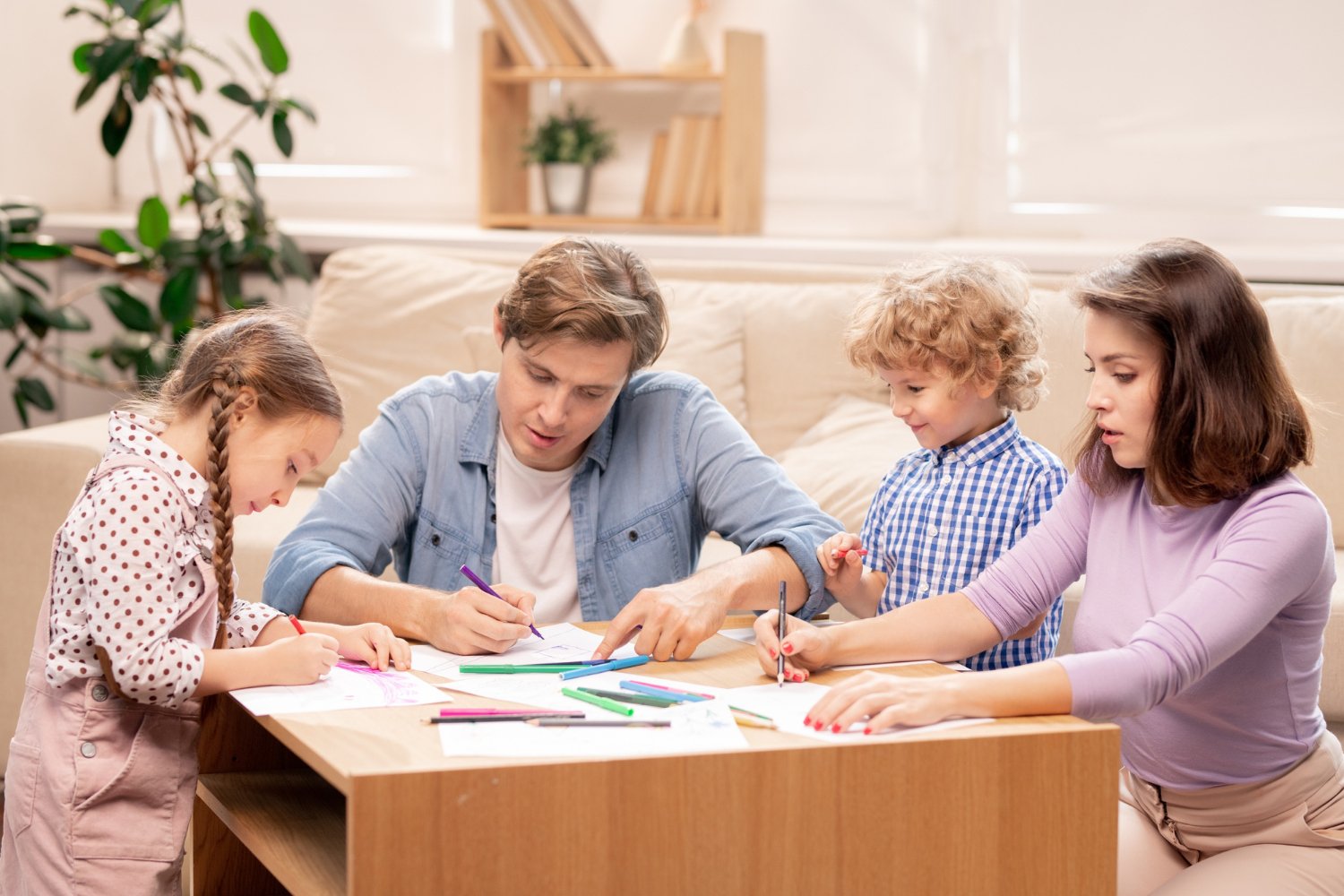
Coloring Books: A Shared Hobby for Children and Parents
Modern life, oversaturated with digital technologies and high levels of stress, pushes families to seek ways of spending meaningful time together. In an era when gadgets dominate daily life, coloring books, which may seem like a simple children’s pastime, have become a powerful tool for restoring connections between family members and enriching emotional life. This hobby is an affordable alternative to screens, requiring no significant financial investment and accessible to any age.
The history of coloring books shows that they were never exclusively for children. As early as 1612, they were used for coloring maps of England and Wales, and in the 1760s the wealthy London elite colored flower engravings. In the 1960s in the United States, satirical publications such as The Executive Coloring Book used the coloring format to mock social and political issues. This demonstrates that coloring books are a universal format capable of adapting to various cultural and social needs.
After 2015, coloring books experienced a true “renaissance” triggered by the global success of Johanna Basford’s Secret Garden. This surge in adult popularity was not accidental. It reflected a deeper social need for simple offline practices that allow people to escape digital overload and high stress levels. The repetitive and rhythmic motions of coloring have a direct therapeutic effect, making it an effective method of relaxation. The revival of coloring as an adult hobby also became a catalyst for its integration into family leisure, where it had long existed as a children’s activity. Thus, adults’ need for stress relief became the basis for reviving this shared family ritual.
The Psychological Portrait of Shared Creativity
Drawing and coloring are not only entertainment but also activities with proven neurobiological benefits. Studies show that creative practices significantly reduce cortisol levels, the stress hormone. After just 45 minutes of drawing, participants showed noticeable reductions. The act of coloring also decreases activity in the amygdala, the key brain area responsible for managing stress-related emotions. These physiological responses suggest that the repetitive, rhythmic motions of coloring act as a natural psychological “medicine” against anxiety and tension.
Coloring also helps achieve a flow state, complete immersion in the activity, when the sense of time and surrounding problems disappear. This effect is similar to meditation, offering escape from everyday worries, which is particularly important in today’s world of constant information overload.
The cognitive benefits of coloring lie in engaging both hemispheres of the brain. The logical side helps with selecting colors and staying within the lines, while the creative side manages color combinations, imagination, and artistic vision. This dual brain stimulation enhances concentration, useful both for children learning focus and adults seeking to restore it.
Coloring as Art Therapy
Coloring is a form of art therapy known as isotherapy, which uses visual art as a therapeutic medium. Its core principle is that the process itself, not the final result, is what matters. Coloring helps individuals express feelings, process emotions, overcome complexes, and reduce fears.
This method is especially effective with children because it is nonverbal. For kids who struggle to express emotions in words, coloring becomes a language for sharing what they feel inside. Through choices of colors, themes, and techniques, children can safely express their emotions. Shared coloring thus becomes not only a joint activity but also a form of family nonverbal communication. The way a child or adult chooses colors or arranges objects in an image may reflect their inner state and family relationships. This hobby therefore becomes a gentle, safe tool for emotional diagnosis and harmonizing relationships.
The Power of Shared Moments
Shared creative activities form the foundation of healthy family relationships. Engaging in them strengthens personal boundaries, builds tolerance and respect, and develops empathy. It deepens mutual identification and provides a way to release negative emotions. Joint hobbies act as a kind of “cement” holding the family together, even across distance.
Turning coloring into a family ritual, for example, an evening practice, creates unique memories, especially around holidays. Such intentional actions transform a temporary activity into a stable ritual associated with positive emotions.
In today’s world, where screens dominate leisure, coloring is the perfect alternative. It draws attention away from digital distractions and back to “living” activities. This helps create genuine family time, free from gadgets, encouraging true interaction and communication.
Coloring vs. Other Hobbies: Unique Advantages
While many family hobbies such as sports, board games, or cooking also strengthen relationships, coloring has unique advantages. Unlike competitive games that can provoke conflict, coloring is non-competitive. This removes the pressure to “win” and allows the focus to remain on process and interaction. It fosters cooperation rather than rivalry, making it ideal for relationship harmony. Coloring is based on “shared-individual creativity,” where each person works on their part within a common space, creating an atmosphere of mutual support and respect.
A Practical Guide: From Choosing to Creating
Choosing the right coloring books
To maximize benefits and enjoyment, it is important to select coloring books and materials suited to each family member’s age and interests.
- Toddlers (ages 2–4): Recommended water-based coloring books, where colors appear with water alone. Paper coloring pages should feature very simple designs with thick outlines and sturdy paper.
- Preschoolers and young children: Educational coloring books can become part of learning. Atlas coloring books that teach culture or history, story-based coloring books combining reading and creativity, or 3D coloring pages for spatial development are all great options. Poster-sized coloring sheets are perfect for whole-family projects.
- Teens and adults: Popular choices include anti-stress coloring books with small, intricate patterns, as well as zen mandalas inspired by zentangle designs.
Materials and atmosphere
Successful family coloring requires not only the right books but also the right setting. Choose a time when everyone is home, such as in the evening. Prepare materials together with children to set the mood. Colored pencils work best for detail, markers for bright hues, and watercolors for softness and blending. Experimenting with gouache or glitter adds variety and originality.
Creating a cozy atmosphere, with music or candles, enhances the experience, turning it into a stable family ritual associated with calm and togetherness.
Life After Coloring: From Hobby to Legacy
The true value of coloring lies not only in the activity itself but also in what comes after. Finished works can be transformed into lasting artifacts of family memories.
- Home décor: Framed pieces can become unique decorations showcasing family creativity.
- Collages and cards: Colored pages can be used for collages, mood boards, or personalized greeting cards.
- Crafts: Pages can be repurposed into notebook covers, wooden decorations, or even Christmas ornaments.
Coloring as a Bridge Between Generations
Coloring, which experienced a renaissance as an anti-stress tool for adults, has proven itself as a powerful solution for family leisure. It serves as a bridge connecting generations raised in different cultural and technological environments.
More than just a pastime, coloring offers families a creative, affordable, and screen-free way to spend time together, transforming blank pages into unique memories. Turning it from a one-time activity into a regular family ritual ensures ongoing joy and emotional well-being for the whole family.
Content
- The Psychological Portrait of Shared Creativity
- Coloring as Art Therapy
- The Power of Shared Moments
- Coloring vs. Other Hobbies: Unique Advantages
- A Practical Guide: From Choosing to Creating
- Choosing the right coloring books
- Materials and atmosphere
- Life After Coloring: From Hobby to Legacy
- Coloring as a Bridge Between Generations