

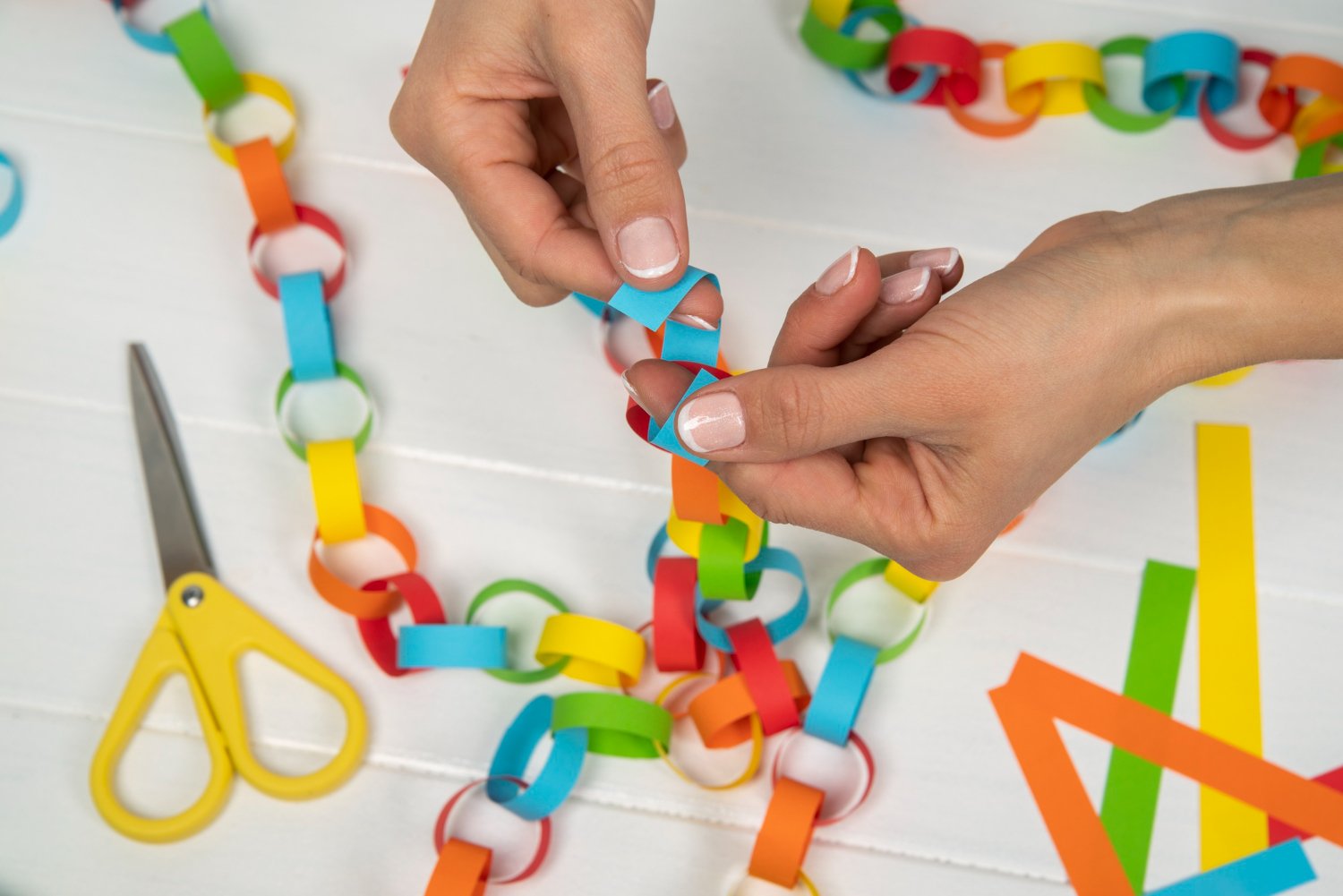
Why Cutouts Matter: From Motor Skills to Cognitive Growth
Paper cutting is often seen only as a simple children’s pastime or a way to keep a child busy. However, according to experts, this seemingly simple activity is a powerful multifunctional tool that plays a critically important role in a child’s overall development. It is not just entertainment, but a purposeful action that prepares a child for school and lays the foundation for forming key life skills. Cutting is a perfect example of the principle of “learning through play,” where a child acquires complex skills without feeling pressure or the need to overcome difficulties. Through playful activity, the child easily learns to concentrate, think logically, develop creative abilities, and prepare for future learning tasks.
Developing Fine Motor Skills
The process of cutting directly influences the development of fine motor skills, which are among the most important abilities in early childhood. Holding scissors and manipulating paper along different lines (straight, zigzag, wavy) and shapes trains the small muscles of the hand, forearm, and fingers. These movements improve muscle strength, tone, and coordination. Such systematic training prepares a child for daily tasks that require precision, such as fastening buttons, tying shoelaces, drawing, and most importantly, writing.
Moreover, fine motor development has a direct impact on neurological growth. Finger movements stimulate numerous nerve endings located at the fingertips. These endings send signals to the brain, activating areas responsible for speech, memory, and other cognitive functions. Thus, every movement with scissors not only strengthens the hand but also creates new neural connections that contribute to intellectual development.
Eye-Hand Synchronization: Perfect Coordination
Cutting is an excellent exercise for improving visual-motor coordination, the skill that allows movements to be controlled by sight. This coordination is essential for successfully completing tasks based on visual models. While cutting, the child constantly follows the line with their eyes while the hand performs the corresponding actions. This connection between visual perception and motor response makes the child’s movements more precise and refined.
Experts note that the eye seems to “teach” the hand, and through manual manipulation with objects, the child gains new knowledge about the surrounding world. Mastering this skill is one of the key indicators of readiness for school. Tasks that involve cutting along outlines or patterns, such as creating collages where cut-out elements must be matched to their silhouettes, directly train this coordination.
Preparing the Hand for Writing
Preparing the hand for writing is not limited to workbooks and pencil exercises. Systematic practice with cutting is one of the most effective ways to prepare for this vital skill. Holding scissors correctly with the thumb, index, and middle fingers forms the same tripod grip used to hold a pen or pencil. This strengthens the small muscles responsible for precision and movement control, preventing the hand from tiring quickly during writing.
In addition to physical preparation, cutting develops spatial awareness, which is crucial for orientation in a notebook. Working with paper helps a child understand concepts such as “left,” “right,” “top,” “bottom,” “above the line,” and “below the line.” The ability to operate with spatial images is necessary for effective learning. Cutting also encourages proper posture at the table, as children instinctively sit upright to perform the task accurately. This forms a habit that will be useful throughout school years. Even such a seemingly simple activity as cutting paper triggers an entire chain of development: from training motor skills to forming visual-motor coordination, which in turn directly prepares a child for more complex learning tasks.
Cognitive Benefits: From Shapes to Logic and Focus
Cutting is a powerful tool for developing logical thinking and spatial orientation. Many didactic tasks involving cutting require the child to think analytically: to distinguish objects, identify their components, and complete missing elements. For example, tasks such as “Cut and paste: match the patch” or assembling puzzles teach children to understand the relationship between parts and the whole. They learn to connect cut images to restore a complete picture, such as matching halves of fruits and berries.
In addition, cutting develops spatial thinking, which is essential for successful adaptation in everyday life. Tasks such as cutting out symmetrical objects, snowflakes, or creating origami teach children to navigate two-dimensional space and imagine how objects relate to one another without physically moving them. This skill is useful not only in learning but also in daily activities, such as assembling construction sets or arranging objects. Analysis shows that most cutting activities are not just free creativity but targeted didactic materials: puzzles, sorting tasks, collages on topics like planets, or handmade storybooks. This highlights that the real value of cutting is revealed when it becomes part of structured, educational play, enabling children to grasp abstract concepts through concrete, physical actions.
Training Attention and Concentration: Skills That Shape Success
Cutting requires a high level of attention and concentration. To accurately follow a contour, especially a winding or zigzag one, a child needs to stay focused on the task for a long time. This demand for focus is an excellent exercise for training attention, as the playful form makes the process engaging and interesting. A child who learns to finish the task, overcoming difficult parts, develops not “patience” in the philosophical or religious sense, but willpower and persistence.
Persistence in this context is not passive endurance of discomfort but an active ability to mobilize resources to achieve a goal. Cutting helps a child learn to shift attention, which is one of the complex mental abilities that requires willpower. Even if the line is not perfectly straight, it is important to praise the child for their effort, as this strengthens confidence and motivates further work. This turns a routine exercise into a valuable experience that shapes a positive attitude toward learning and development.
Creativity Without Limits: Unlocking Creative Potential
Cutting is a basic tool for creative self-expression. By cutting out details, the child obtains ready-made elements for creating unique story-based collages. Even working with a prepared template, such as making the collage “Kitten on a Scooter” or “Autumn Paper Cutouts,” helps develop imagination and creative abilities. The child learns to combine different shapes, colors, and elements to create their own visual story.
The use of colored paper is an additional stimulus, as bright colors motivate the child to work and make contours easier to distinguish. Collages such as “My Dream Ice Cream” or “Ukrainian Borscht” allow the child not only to repeat actions but to bring their own ideas to life.
Story-Based Cutting: From Picture to Narrative
Paper cutting can become the foundation of an engaging storytelling process. An example is the creation of “handmade books,” where the child cuts out illustrations and then composes small books with favorite fairy tales, such as “The Turnip,” “The Mitten,” or “The Three Bears.” This process develops not only fine motor skills but also speech competence, imagination, and the ability to understand storylines and their sequence.
Other thematic cutouts related to exploring the world expand the child’s knowledge. For example, a collage on the theme of the Solar System or professions such as “The Builder and His Tools” helps to acquire new knowledge in an engaging and interactive way. This allows the child to connect physical actions with abstract concepts, making the learning process deep and meaningful.
Expert Tips for Success
The effectiveness of cutting as a developmental tool depends not only on the activity itself but also on the adult’s teaching approach. It is important to demonstrate movements slowly and clearly. Most importantly, children should be praised for their effort rather than for a perfectly straight result. Encouragement strengthens motivation and self-esteem, helping the child not to fear mistakes. This turns a simple action into a valuable life lesson, shaping a positive attitude toward learning and the ability to complete tasks. Proper guidance and the right motivation are key to developing persistence and a positive approach to education.
Cutting as a Multifaceted Tool
Cutting creates a strong physical foundation by developing fine motor skills and eye-hand coordination, both essential for preparing the hand for writing. It also stimulates cognitive abilities, shaping logical and spatial thinking while training attention and persistence. Finally, cutting is an inexhaustible source of creative self-expression and broadening horizons.
By encouraging children to engage in cutting, parents and educators not only help them spend time usefully but also make a valuable investment in their future. It is a simple yet effective activity that transforms ordinary paper and scissors into a powerful means of developing a well-rounded and successful personality.
Content
- Developing Fine Motor Skills
- Eye-Hand Synchronization: Perfect Coordination
- Preparing the Hand for Writing
- Cognitive Benefits: From Shapes to Logic and Focus
- Training Attention and Concentration: Skills That Shape Success
- Creativity Without Limits: Unlocking Creative Potential
- Story-Based Cutting: From Picture to Narrative
- Expert Tips for Success
- Cutting as a Multifaceted Tool